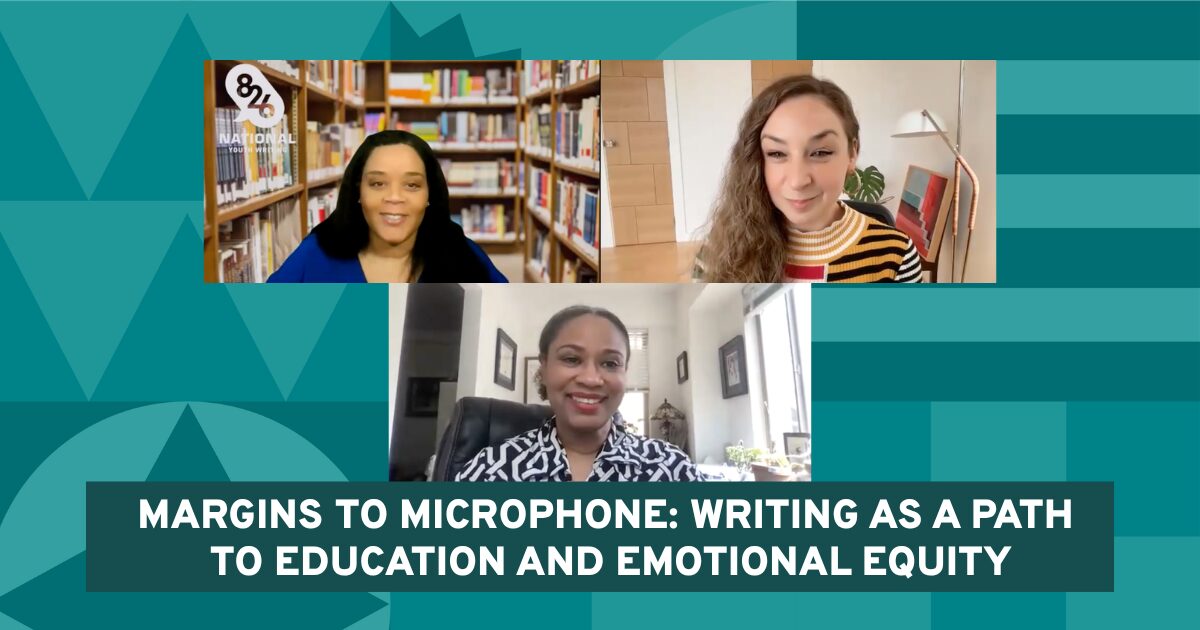
On April 15, 2026, 826 National hosted Margins to Microphones:Writing as a Path to Education and Emotional Equity, a public event unpacking the relationship between writing, literacy, and mental well-being.
Laura Brief, M.A., Ed.M., CEO, 826 National Youth Writing, and Miah Daughtery, Ed.D., educator, researcher, literary expert, and vice chair of 826 National’s board made the case that the country’s current literacy and mental health crises have a shared solution: writing.
They presented clear evidence—both research and experiential—that the U.S. literacy crisis is not just about declining reading scores but about the systemic neglect of writing, especially for marginalized students.
“Here’s the truth about literacy in America: we talk about and assess reading endlessly, but we’ve stopped asking if students can write. The last national scored writing assessment was in 2011. That data indicated a serious problem: 9 out of 10 Black and Hispanic twelfth graders did not write at grade-level proficiency. Does anyone think writing has gotten better?” Miah Daughtery, Ed.D., educator, researcher and literacy expert asked.
At the same time, reading scores have fallen to their lowest levels in three decades. Just 31% of eighth graders and 26% of twelfth graders read at or above proficiency. We’ve built an education system that treats writing, the act of producing language, of shaping thought, as an afterthought. To reverse course on the nation’s literacy crisis, we must remember that writing is as important as reading. And that each is the key to the other.
Writing also remains an overlooked force for change in the youth mental health crisis, despite its proven ability to serve as a tool for both prevention and intervention. Today, one in five children in the United States struggles with a mental-health challenge, but only 20% receive supportive care. The suicide rate for children of color is nearly twice that of their peers. And 40% of teens report persistent feelings of sadness or hopelessness.
“If the literacy crisis is partially about whose stories are told, the mental health crisis is about what happens when young people can’t tell theirs. When young people don’t see their own stories reflected back, they start to question if their stories matter. We talk about mental health as if our only tool is the counselor’s office, but mental health support can also take place on the page,” Laura Brief, CEO of 826 National Youth Writing emphasized.
To scale writing as a mental health intervention, 826 National launched the Write to Thrive Fund, providing grants, educator training, and research support to embed writing into schools and youth programs. It is first of kind to invest in writing as prevention and to aim to bring these proven benefits to scale.
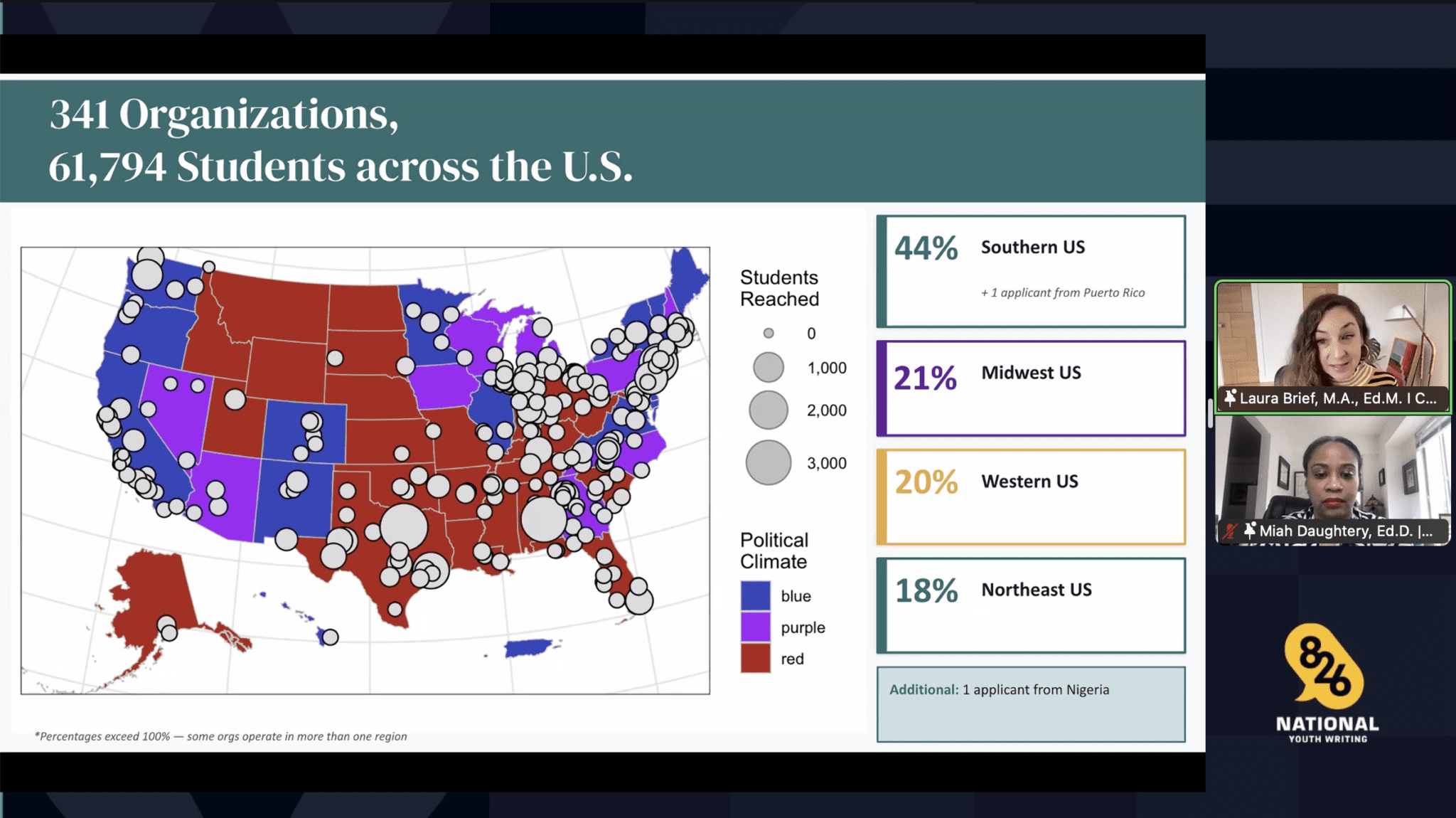
Demand far exceeded expectations: organizations serving nearly 1 million students, with the majority from low-income and historically underserved communities, applied. Most applicants already believe in writing’s impact but lack resources to implement programs. By investing in writing, the Write to Thrive initiative seeks to simultaneously address literacy inequity and youth mental health, giving students both the skills and the language to understand themselves and be heard.
A pilot cohort across six diverse sites—urban, rural, tribal, and alternative education settings, is already underway:
- Southern Indian Health Council – A tribal health center serving Native youth along the California-Arizona border, where wellness is understood as inseparable from culture and community.
- COR Inc – A nonprofit embedding the program directly into 12th-grade English classes at a Title I high school in Atlanta with a 5% grade-level reading proficiency rate.
- The Boys & Girls Clubs of Greater Dallas – A large-scale urban afterschool system serving hundreds of young people across the city.
- YouthBuild Philadelphia – A re-engagement school serving young adults ages 17-20 who have left traditional high school, where writing becomes a tool for processing experience and imagining a future.
- 826 MSP in Minneapolis, running weekly writing workshops for 6th and 7th graders during what their team calls ‘a crucial time’ for students navigating community tensions and uncertainty.
- The Boys & Girls Clubs of Fort Smith, Arkansas – A rural community where access to writing programs has been nearly nonexistent.
Each site will serve between 100 and 500 students through Write to Thrive, implementing 826’s tailored, SEL-integrated curriculum across eight consecutive instructional sessions—supported by facilitator training, research embedded from the start, and the funding to bring it to life.
More than 50 partners, community members, funders, and youth-serving professionals attended 826 National’s public event, representing public schools, universities, nonprofits, foundations, and mental health and policy organizations from across the country seeking solutions.
Margins to Microphones: Writing as a Path to Education and Emotional Equity advocated for writing not as enrichment but as essential infrastructure.
To access the event recording click here.
To invest in the Write to Thrive Fund click here.
For media inquiries, please contact Heidi Lepe at heidi@826national.org
###
826 National is the largest youth writing network in the United States, amplifying the impact of writing and publishing centers across the country, along with the words of young writers. We serve as an international proof point for writing as a tool for young people to ignite and channel their creativity, explore identity, advocate for themselves and their community, and achieve academic and professional success. The 826 Network serves approximately 903,000 students with free writing programs and resources across nine chapters in major U.S. cities—Boston, Chicago, Detroit/Ann Arbor, Los Angeles, Minneapolis/St. Paul, New Orleans, New York City, San Francisco, and Washington, D.C.—and through 826 Digital. Our online platform, 826 Digital, supports over 23,000 educators nationwide with teaching tools and professional support. Visit 826national.org to learn more about our writing movement.